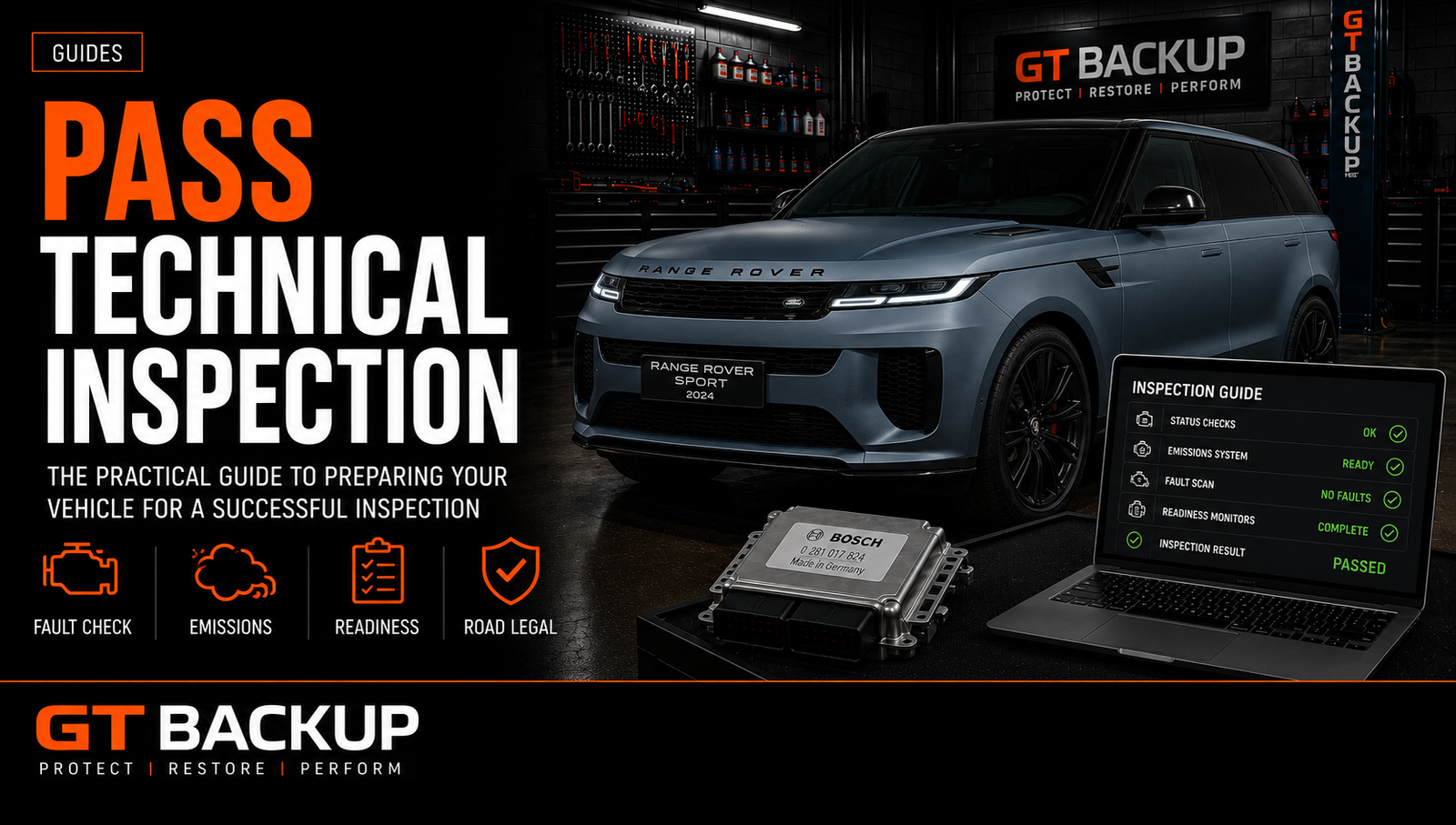
A technical inspection checks whether a vehicle meets defined roadworthiness and emissions criteria on the day of the test. Depending on the country, vehicle age and fuel type, the procedure can include warning lamps, visible emissions equipment, exhaust-gas or smoke measurements and electronic diagnostic information. Correct factory ECU software is important, but software restoration alone never guarantees a pass: the hardware, sensors and emissions system must also function correctly.
What is a technical inspection?
A periodic roadworthiness test is a legally defined inspection for vehicles used on public roads. It is called contrôle technique in France, MOT in Great Britain, Hauptuntersuchung in Germany and by other names elsewhere.
European Directive 2014/45/EU establishes minimum requirements for periodic testing, while each country implements its own procedures, classifications, intervals and equipment. Therefore, a workshop should consult the current national manual rather than assume that every European test is identical.
A technical inspection is not a complete certification of hidden ECU software, mechanical condition or legal conformity. It samples defined items using an approved procedure.
What emissions items may be checked?
In practice, the applicable inspection can consider:
- the malfunction indicator lamp and other required warnings;
- visible and identifiable emissions-control equipment;
- exhaust leaks that affect measurement;
- petrol carbon monoxide, hydrocarbons and lambda;
- diesel smoke opacity;
- obvious DPF, catalyst, EGR or SCR modification;
- OBD information where the national procedure requires or permits it;
- whether the emissions test can be completed safely.
The exact list changes with vehicle category, first-use date, fuel, hybrid configuration and national rules. Never promise a test result from a generic checklist.
Technical inspection rules are country-specific
| Framework | Typical scope | Important limitation |
|---|---|---|
| European Union minimum framework | Periodic roadworthiness and emissions requirements | Member States implement detailed national procedures |
| France | French contrôle technique instructions and defect classifications | Use current UTAC-OTC and regulatory documentation |
| Great Britain | MOT manual, petrol-gas tests, diesel opacity, MIL and visible equipment | Criteria depend on age, type and test section |
| Germany | HU/AU requirements under German rules | Do not substitute UK or French criteria |
Therefore, before preparing a vehicle, identify where it is registered and tested. Advice valid for an MOT may not describe a French technical inspection.
Does the technical inspection read the ECU?
Sometimes, but not universally in the same way. European rules allow or require OBD use in defined circumstances, and national procedures determine what the tester accesses and how the result affects classification.
A scan tool used by a repair workshop can retrieve much more information than a periodic inspection procedure. Conversely, a vehicle can fail for a warning lamp, visible missing equipment or measured emissions without a deep ECU interrogation.
Meanwhile, readiness monitors are important diagnostic evidence, but do not assume that every inspection reads or grades them identically. Use the current manual for the exact test jurisdiction.
Why deleted emissions systems can fail
As a result, an emissions delete can create several failure routes:
- required equipment is missing or visibly modified;
- the engine warning lamp indicates a malfunction or does not operate correctly;
- smoke, CO, HC, lambda or other measured values exceed limits;
- an exhaust leak prevents reliable measurement;
- the ECU or aftertreatment system reports a fault;
- a physically damaged DPF emits visible smoke;
- the tester cannot complete the prescribed procedure.
A file that suppresses DTCs does not make the exhaust compliant. Likewise, a visually intact casing does not prove that its substrate or monitoring remains functional.
Factory ECU software does not guarantee a pass
Verified original software restores the manufacturer’s control and diagnostic strategies for the matched ECU version. However, it cannot repair missing hardware, a failed NOx sensor, a blocked filter, a leaking injector or a damaged catalyst.
After software restoration, previously hidden faults may return immediately. This is useful: the DTCs reveal what must still be repaired. Clearing them without correcting the cause only delays the warning until the monitor runs again.
Consequently, responsible technical inspection preparation combines factory-correct software with physical diagnosis and repair.
Technical inspection preparation workflow
- Identify the applicable rules. Confirm country, vehicle class, fuel, first-use date and test type.
- Scan the complete vehicle. Record current, pending and permanent DTCs before clearing anything.
- Check warning lamps. Confirm the MIL illuminates and extinguishes according to the manufacturer’s strategy.
- Inspect emissions hardware. Verify DPF, GPF, catalyst, EGR, SCR and sensors are present and undamaged.
- Repair leaks. Intake and exhaust leaks can alter combustion, sensor readings and test results.
- Review live data. Check temperatures, pressure, lambda, NOx, fuel trims and aftertreatment status where relevant.
- Verify ECU software. Preserve the current read and restore the exact approved calibration if it was modified.
- Complete adaptations. Register replacement components and reset values only after genuine service work.
- Validate monitors. Perform the manufacturer’s repair verification under safe and legal conditions.
- Pre-test emissions. Measure the vehicle with suitable equipment when possible.
Check the malfunction indicator lamp
The MIL provides basic evidence that the diagnostic system can warn about an emissions fault. A lamp that stays on, fails to illuminate during its check sequence or has been physically disabled can cause rejection under applicable rules.
Do not remove the bulb, cover the display or modify the dashboard logic. Scan the responsible module, diagnose the stored fault and confirm the lamp operates normally after repair.
In addition, some vehicles display separate AdBlue, DPF or emissions warnings. Interpret these using the manufacturer manual and national test criteria.
Petrol technical inspection preparation
Petrol testing can include CO, HC and lambda measurements at specified engine speeds and temperatures. Exact limits may come from vehicle-specific data or national defaults.
Before the technical inspection, check ignition, fuel control, lambda sensors, catalyst efficiency, intake leaks, exhaust leaks and engine temperature. A misfire can rapidly damage a catalyst or GPF and create excessive HC.
Next, review short- and long-term fuel trims rather than replacing a lambda sensor solely from one code. Ensure the engine reaches normal operating temperature and that no unsafe condition prevents testing.
Diesel technical inspection preparation
Diesel procedures commonly assess smoke opacity and visible emissions equipment. A test can involve repeated free accelerations, so first confirm oil level, engine condition, timing-drive condition and normal operating temperature.
Do not use aggressive driving or an unsafe forced regeneration simply to prepare for inspection. Diagnose excessive smoke, boost leaks, injector faults, EGR problems, oil consumption and DPF loading.
Furthermore, where a DPF is fitted, visible smoke can indicate a serious problem even when a delete file suppresses the warning.
Hybrid vehicles and inspection differences
By contrast, hybrid test procedures can differ because the combustion engine may not run continuously and some national smoke-test provisions exclude certain hybrids. The technician must follow the approved method for maintenance mode, engine operation and emissions measurement.
Never improvise a workshop mode or force the engine to run without the manufacturer procedure. Incorrect operation can create DTCs or safety risks.
Inspect DPF and GPF systems
For a DPF or GPF, compare calculated loading with physical evidence. Check differential pressure, hoses, exhaust temperatures, regeneration history and downstream particulate sensing where fitted.
A forced regeneration is not appropriate for a cracked, melted, fuel-contaminated or excessively loaded filter. Professional cleaning can help an intact ash-loaded filter, while structural damage requires replacement.
After real service work, perform the correct adaptation and verify that the ECU monitor completes. See our guides to P2002 and P20EE diagnosis and GPF restoration.
Inspect SCR and AdBlue systems
Similarly, a roadworthy SCR system needs correct AdBlue quality, pressure, injector operation, exhaust temperature, NOx sensing and catalyst conversion. A filled tank alone does not prove system health.
Diagnose crystallization, leaks, heater faults, pump pressure, dosing quantity and upstream/downstream NOx values. Complete manufacturer adaptations after replacing a sensor, injector, pump or catalyst.
An active restart countdown may require a prescribed validation routine after repair. Repeatedly clearing codes is not a substitute.
Readiness monitors after ECU restoration
Disconnecting the battery, clearing DTCs or writing the ECU can reset diagnostic monitor status on some vehicles. Monitors then need appropriate operating conditions before reporting completion.
However, there is no universal “drive for a few miles” formula. Different monitors require specific temperatures, speeds, loads, fuel levels and fault-free operation. Follow the manufacturer drive cycle or guided test.
Do not attempt to manipulate readiness values. Genuine completion provides evidence that the repaired systems have run their checks.
How early should preparation begin?
Begin diagnosis well before the appointment. A last-minute stock file write can expose hardware faults, reset adaptations or leave insufficient time for monitor completion and parts replacement.
For a vehicle with unknown or modified software, allow time to:
- read and preserve the ECU data;
- identify the exact factory calibration;
- repair all physical emissions components;
- complete coding and adaptations;
- perform controlled road verification;
- recheck for pending DTCs and leaks.
Ultimately, the sensible objective is a correctly repaired vehicle, not a temporary warning-free dashboard.
Common technical inspection myths
“No engine light means it will pass”
No. The vehicle can still fail measured emissions, visible equipment checks, smoke or an incomplete test.
“A stock file guarantees a pass”
Not necessarily. Factory software restores diagnostics but cannot repair defective hardware.
“Passing proves the vehicle is fully legal”
No. The test covers defined items and does not certify every hidden modification or contractual issue.
“Clearing codes the night before is enough”
It is not enough. Faults can return, permanent codes can remain and monitor status can reset.
“Off-road only makes a road-car delete acceptable”
No automatic exemption exists. The legal analysis depends on vehicle category, actual use and jurisdiction, not a label on an invoice.
What if the vehicle fails?
After a failed test, use the official failure report as diagnostic evidence. It should identify the tested item, measured result and defect classification. Avoid replacing parts from the wording alone; reproduce the condition and follow the vehicle test plan.
For excessive petrol emissions, analyze CO, HC and lambda together. For diesel smoke, investigate combustion, air supply, oil consumption and aftertreatment. For a MIL failure, scan the modules and confirm the lamp circuit.
Finally, after repair, complete the required retest within the applicable national time and scope.
Technical inspection and emissions law
A successful periodic test does not override emissions, type-approval, registration, insurance or modification law. Inspection procedures have defined limits and cannot examine every software function.
Conversely, a failure does not by itself prove intentional tampering. Ordinary component faults can cause the same result and require diagnosis.
For the wider legal framework, consult our emissions law guide.
Restoring the ECU before technical inspection
If emissions strategies were modified, preserve the current ECU read and record the complete hardware and software identification. Match the replacement file to the exact engine, transmission, emissions level and controller version.
Use the supported OBD, Bench or Boot procedure with stable power and verified checksum handling. Then complete coding, adaptations and post-write diagnosis.
Do not write a random ORI file solely because the filename resembles the vehicle. Learn more in our Stock ECU restore guide.
Official technical inspection references
For the European minimum framework, consult Directive 2014/45/EU. For Great Britain, use the current MOT emissions inspection manual.
For France, consult the current official regulatory and UTAC-OTC documentation applicable to the vehicle category. Always verify the latest national text before giving test-specific advice.
Technical inspection support from GTBackup
For software verification, GTBackup can inspect an ECU read for altered DPF, GPF, EGR, SCR, lambda or DTC strategies and help identify verified factory software for supported restoration work.
Send the complete ECU identification, vehicle details, current read, programming tool, protocol and full diagnostic report. File analysis cannot guarantee a pass and does not replace physical inspection or emissions measurement.
Review our ECU file service pricing or learn how to read an ECU safely.
Conclusion
A technical inspection is passed by meeting the applicable test criteria with a genuinely functional vehicle. Prepare by identifying the national rules, scanning all modules, repairing emissions hardware, restoring the exact factory ECU strategy when needed and validating the system before the appointment. Never promise that software alone will secure a pass. Honest diagnosis, documented repair and correct monitoring provide the strongest preparation.