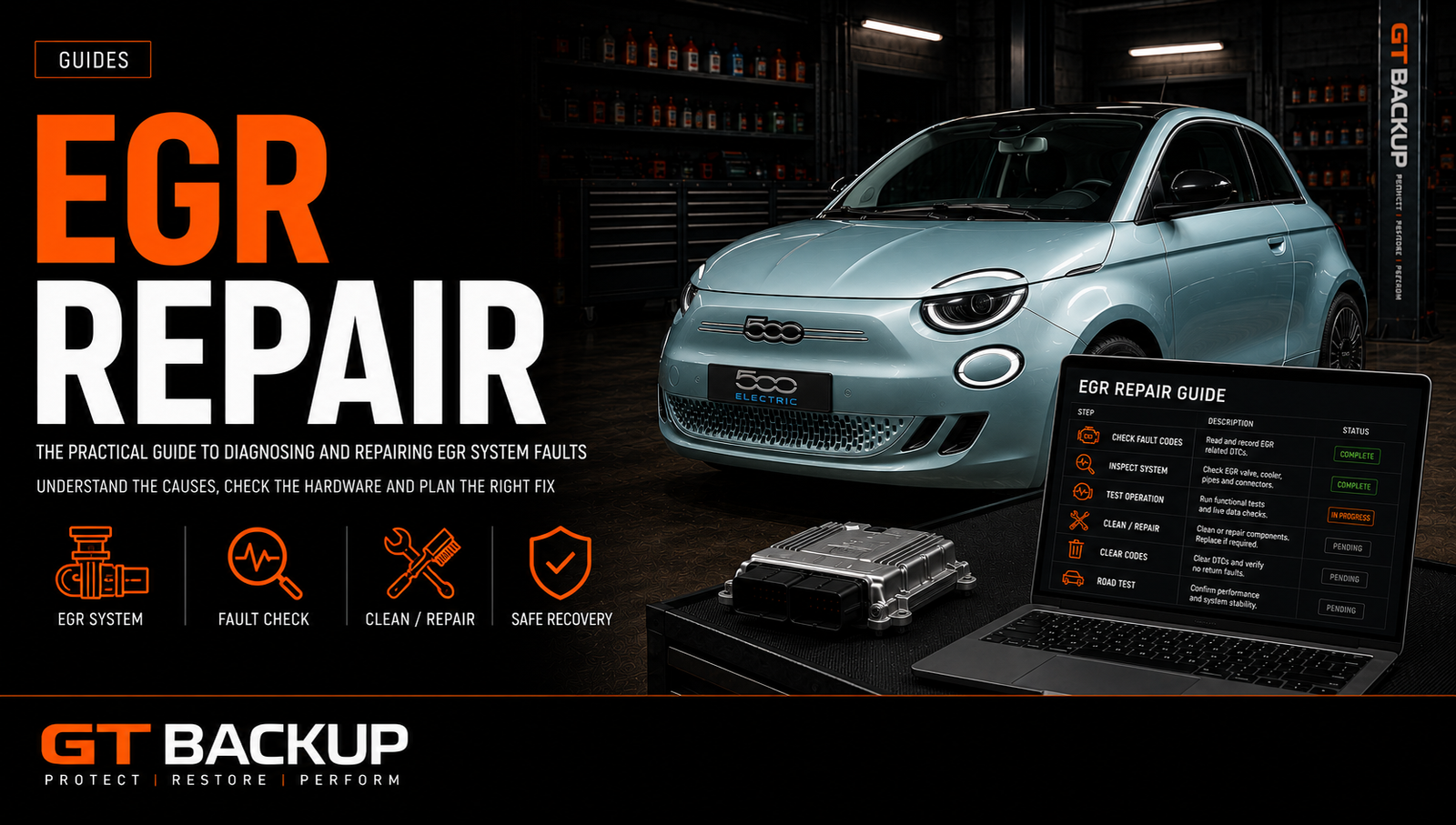
EGR repair should begin with diagnosis, because the valve is only one part of the exhaust gas recirculation system. Carbon contamination, a failed actuator, a blocked cooler, leaking vacuum lines, wiring faults, air-metering errors or unsuitable ECU software can produce similar symptoms. Cleaning may help a serviceable contaminated part, while an electrically or mechanically damaged valve usually needs replacement.
What does the EGR system do?
Exhaust gas recirculation sends a controlled quantity of exhaust gas back into the intake. This reduces combustion temperature and therefore limits the formation of nitrogen oxides, commonly called NOx. Modern diesel engines can use cooled high-pressure EGR, low-pressure EGR or both. Petrol engines may also use external or internal recirculation strategies.
The ECU calculates the requested EGR flow from engine speed, load, temperature, air mass, boost pressure and emissions strategy. It then commands an electric or vacuum-operated valve and checks the result through sensors and plausibility models.
Consequently, an EGR fault code does not automatically prove that the valve itself has failed.
Common EGR repair symptoms
An EGR system fault can produce one or several symptoms:
- engine warning lamp;
- rough idle, hesitation or stalling;
- reduced power or limp mode;
- jerking during light acceleration;
- poor throttle response;
- increased fuel consumption;
- excessive smoke or higher emissions;
- longer or more frequent DPF regeneration;
- whistling, coolant loss or exhaust smell near the EGR cooler;
- stored airflow, boost or EGR-related DTCs.
Some contaminated electric valves can still pass a basic actuator test. HELLA notes that severe deposits can restrict the effective opening even when diagnostics do not clearly identify the mechanical problem. Therefore, compare commanded and actual behavior rather than relying on one test result.
Typical EGR diagnostic trouble codes
| Code | General meaning | Possible causes |
|---|---|---|
| P0400 | EGR flow malfunction | Valve, passages, vacuum, wiring or airflow calculation |
| P0401 | Insufficient EGR flow | Carbon blockage, restricted cooler, valve not opening or sensor error |
| P0402 | Excessive EGR flow | Valve stuck open, control fault or incorrect feedback |
| P0403 | EGR control circuit | Wiring, connector, power supply, actuator or ECU driver |
| P0404 | Range or performance | Position feedback, deposits, sticking mechanism or adaptation |
| P0405/P0406 | Position sensor signal low/high | Sensor, wiring, reference voltage or valve electronics |
Manufacturer-specific codes and test plans take priority. Always save the complete scan before clearing anything, including freeze-frame data and related faults in the air, boost, DPF and cooling systems.
EGR repair diagnosis step by step
- Confirm the complaint. Note when the symptom occurs, engine temperature, load and recent repairs.
- Scan every relevant module. Record DTCs, freeze frames and software identification.
- Inspect visually. Check connectors, damaged wiring, vacuum hoses, coolant traces, exhaust leaks and loose pipework.
- Review live data. Compare requested and actual EGR position, air mass, manifold pressure and temperature values.
- Run actuator tests. Observe whether the command changes airflow, engine sound or position feedback.
- Check the surrounding system. Test the MAF, MAP, throttle flap, vacuum supply, cooler and intake passages.
- Inspect mechanically when justified. Remove the component according to manufacturer instructions and assess deposits, movement, sealing and damage.
- Verify ECU software. Identify non-standard EGR strategies, hidden DTCs or an incorrect calibration only after mechanical and electrical evidence has been collected.
Check the air and vacuum systems first
A low EGR-flow code can appear when the ECU does not observe the expected change in air mass. A biased MAF sensor, intake leak, boost leak, blocked passage or regulating-throttle fault can therefore imitate an EGR valve problem.
On vacuum-operated systems, check the pump supply, solenoid, hoses and diaphragm with suitable equipment. A hose can look intact while leaking under movement or temperature. For electric valves, verify power, ground, reference voltage, signal integrity and connector condition using the correct wiring diagram.
This evidence prevents unnecessary parts replacement and makes EGR repair more reliable.
EGR cleaning: when can it help?
Cleaning can help when inspection confirms carbon contamination and the component remains mechanically and electrically serviceable. The procedure must suit the exact valve, cooler and manufacturer guidance. Protect motors, sensors and electronics from aggressive solvent, liquid ingress and abrasive debris.
Remove loose deposits without forcing the valve mechanism. Clean connected passages only when access and procedure allow it, because restoring the valve alone will not solve a blocked intake or cooler. Replace required gaskets, seals and single-use fasteners.
However, cleaning is not a universal remedy. Motorservice warns that cleaning a defective EGR component will not repair it and can damage a functioning component if the method is unsuitable. That is why the inspection result—not price alone—must determine the EGR repair.
When should the EGR valve be replaced?
Replacement is normally the appropriate choice when the valve has a failed motor or position sensor, excessive play, damaged gears, a burned or deformed seat, internal leakage, severe corrosion or a mechanism that remains seized after approved inspection.
Foreign objects from the exhaust system can also jam the valve. Motorservice documents cases involving catalyst fragments or welding debris; replacing the valve without removing the source can cause a repeat failure.
Use the correct part number and current supersession. Some vehicles require a diagnostic command to place the actuator in an installation position. Forcing the component into place can deform the valve disc or stem.
Do not overlook the EGR cooler
A cooler can restrict gas flow, leak coolant internally or externally, and contaminate the intake. Symptoms can include unexplained coolant loss, steam, deposits, exhaust smell or recurring flow faults.
Pressure-test or inspect the circuit according to manufacturer instructions. On vehicles covered by a recall or technical campaign, follow the manufacturer process. Never bypass a leaking cooler as a substitute for repair.
EGR repair: cleaning versus replacement
| Finding | Possible action | Why |
|---|---|---|
| Serviceable valve with removable deposits | Approved cleaning and retest | May restore movement and flow |
| Failed electronics or position sensor | Replace valve | Cleaning cannot repair electronics |
| Damaged seat, gears or stem | Replace valve | Mechanical integrity is lost |
| Blocked passages or cooler | Repair the restriction | A new valve alone will not restore flow |
| Vacuum or wiring fault | Repair control circuit | The valve may be functional |
| Non-standard ECU calibration | Restore verified factory strategy | Hardware needs correct control and monitoring |
What must be done after EGR replacement?
After installation, refill and bleed the cooling system if the circuit was opened. Then perform any required EGR adaptation, learned-value reset, actuator initialization or software update with suitable diagnostic equipment.
Clear codes only after completing the repair. Start the engine, inspect for coolant, exhaust and intake leaks, and monitor requested versus actual EGR data. Confirm that air mass and boost respond plausibly during controlled operating conditions.
Finally, complete an appropriate road test and rescan the vehicle. Readiness monitors may require several operating cycles; an immediately clear dashboard does not prove the repair is complete.

What is an EGR software delete?
An EGR delete changes ECU software so that it no longer commands, monitors or reports the system in the original way. Depending on the file, it can alter valve control, airflow models, diagnostic thresholds and DTC reporting.
This is not equivalent to EGR repair. It can hide the warning while leaving a blocked valve, leaking cooler, wiring fault or intake restriction unresolved. Suppressing one DTC also does not prove that all dependent strategies remain correct.
For a road vehicle, restore functional hardware and verified factory software. Do not market a disclaimer such as “off-road use only” as an automatic legal exemption; vehicle category, use and jurisdiction determine the applicable rules.
EGR law and roadworthiness
European emissions legislation prohibits defeat devices that reduce the effectiveness of emissions-control systems, subject to narrow statutory exceptions. The current UK MOT manual also lists identifiable EGR valves among the emissions equipment checked and calls for rejection where original equipment is missing, obviously modified or obviously defective on applicable vehicles.
National enforcement differs, so workshops should verify current official rules. Passing a periodic inspection does not itself certify every hidden ECU strategy as lawful.
For broader context, read our guide to emissions law.
Restoring ECU software during EGR repair
If a previous file disabled EGR operation or diagnostic reporting, a mechanical repair may reveal nothing until the ECU returns to the correct strategy. Begin with a complete controller identification and preserve the current read before writing.
Match the original file to the exact ECU hardware, software, engine, gearbox and emissions configuration. Confirm the programming protocol, power support and checksum handling. After writing, verify software identification, adaptations, DTC operation and live data.
A stock file cannot repair a seized valve or leaking cooler. Conversely, a new valve cannot work as designed when the ECU still contains an EGR-off calibration. Successful EGR repair requires both sides to agree.
Why EGR faults often return
Repeated contamination can be a consequence rather than the original cause. Check excessive oil carry-over, combustion quality, injector correction, thermostat operation, short-trip use, DPF loading, boost leaks and crankcase ventilation where relevant.
Also inspect the entire flow path. Deposits left in the intake manifold, cooler or pipework can reproduce a restriction soon after fitting a new valve.
A documented root-cause diagnosis costs less than repeatedly cleaning or replacing the same component.
Official EGR repair references
Useful professional references include the HELLA EGR technical guide, Motorservice EGR troubleshooting guidance and the current UK MOT emissions-equipment manual.
Always prioritize the vehicle manufacturer’s wiring diagrams, test plan, repair manual, technical bulletins and current software requirements for the exact application.
EGR repair support from GTBackup
GTBackup can assess an ECU read when a workshop suspects an EGR-off modification or needs a verified original calibration for compliant restoration. Send the complete ECU identification, vehicle details, current file, programming tool, connection mode and all relevant DTCs.
Our file work supports diagnosis; it does not replace physical inspection. See Stock ECU restore, learn how to read an ECU or review our ECU file service pricing.
Conclusion
Effective EGR repair identifies the cause before choosing cleaning, replacement or software restoration. Test the air, vacuum, electrical and cooling systems; inspect the valve and passages; follow component-specific cleaning limits; and replace damaged parts. If the ECU has modified software, restore a verified factory strategy and confirm live data after programming. This approach repairs the vehicle instead of merely hiding its warning light.