
ECU tuning jargon can make straightforward workshop operations sound more complicated than they are. Clear definitions help technicians, file-service customers and newcomers communicate accurately, compare reading methods and avoid mistakes when interpreting software, calibration or diagnostic information.
This practical glossary explains common file, memory, programming, calibration and diagnostic terms in plain English. A label can still mean different things between ECU families and tools, so always combine terminology with the exact hardware number, software number, protocol and intended operation.
ECU tuning jargon: controller and identification terms
- ECU: Engine Control Unit, the electronic controller that manages engine operation. Manufacturers may also call it an ECM.
- TCU: Transmission Control Unit for an automatic, dual-clutch or continuously variable transmission.
- BCM: Body Control Module, responsible for many body and comfort functions rather than engine calibration.
- HW or hardware number: identifies the physical ECU design or revision. Similar-looking ECUs may use incompatible hardware.
- SW or software number: identifies the program or calibration version installed in the controller.
- Calibration ID: an identifier for a specific calibration set or software release.
- VIN: Vehicle Identification Number. It helps establish vehicle context but cannot replace ECU hardware and software identification.
- CVN: Calibration Verification Number, a calculated value used by some diagnostic and compliance systems to identify calibration data.
ECU tuning jargon for file types
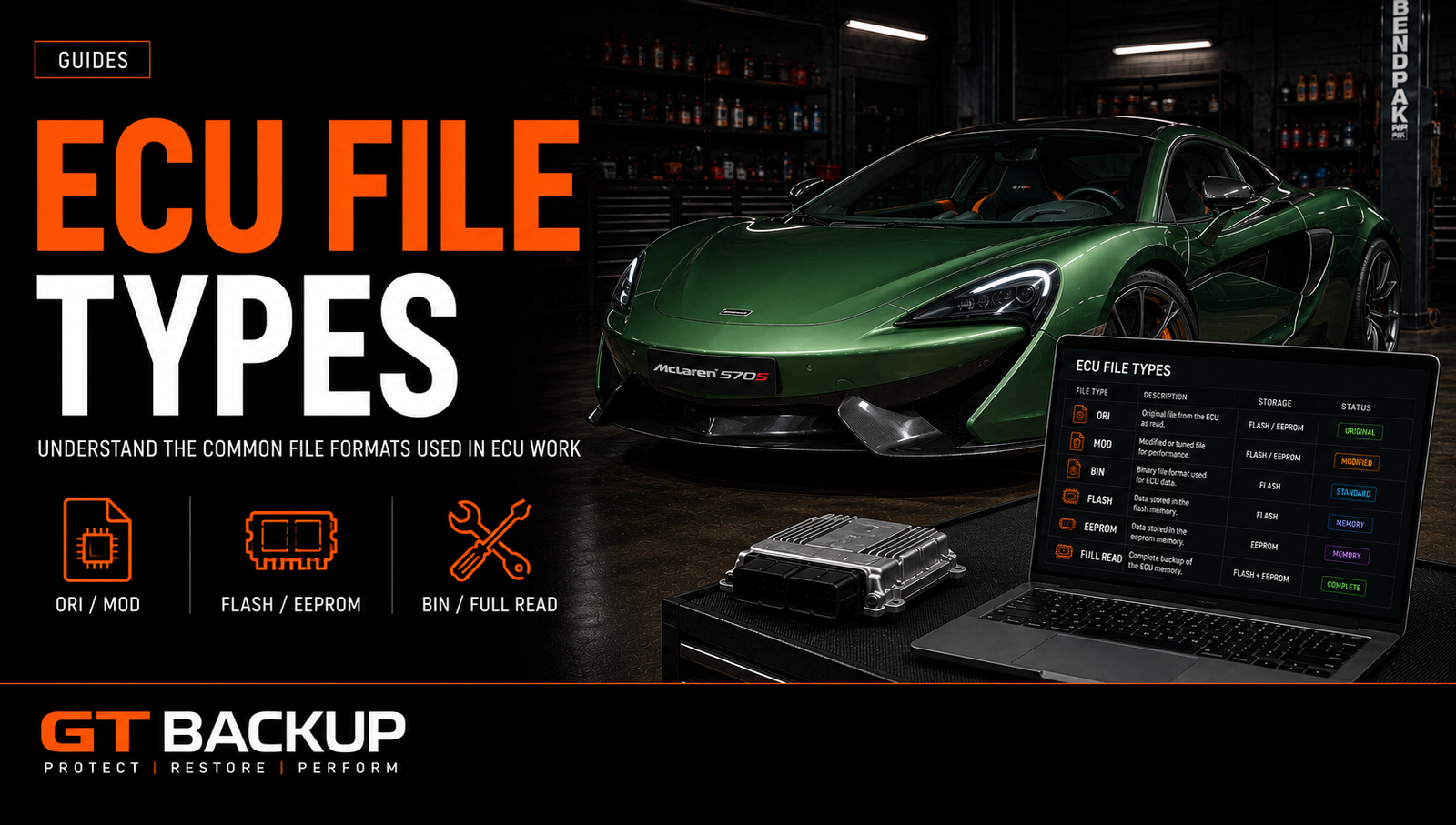
- ORI: an original, unmodified file. The filename alone does not prove originality; compare its identification and data with a trusted reference.
- MOD: a file containing one or more calibration or software changes.
- BIN or binary: raw data stored as bytes. A
.binextension does not identify the ECU, software version or memory area. - Calibration file: a selected area containing maps and related tunable data rather than every ECU memory.
- Full read: the broadest set of memories available through a specific ECU, tool and protocol. It is not automatically a universal recovery backup.
- Virtual read: matching original software retrieved from a tool database after ECU identification instead of physically reading every memory from the vehicle.
- Backup: preserved original data intended for comparison or restoration. State whether it includes flash, EEPROM or a tool-specific container.
- Container or package: a tool-specific file that may combine, compress or encrypt several data areas.
Memory terms: flash, EEPROM and MCU
| Term | Plain-language meaning | Why it matters |
|---|---|---|
| Flash | Non-volatile memory commonly holding program code and calibration data | Used for software identification, tuning and restoration |
| EEPROM | Memory often holding coding, configuration, adaptations or identity data | May be required for replacement or cloning |
| Emulated EEPROM | Flash area managed to behave like EEPROM | Its location and handling depend on ECU architecture |
| MCU | The microcontroller that executes ECU software | Defines processor family and supported access methods |
| Internal memory | Memory integrated into the processor | May require processor-level access |
| External memory | A separate flash or EEPROM component | Can contain program, calibration or configuration data |
Memory location varies between controllers. Never assume that EEPROM always contains immobiliser data or that the main flash always includes everything required for cloning. Review the dedicated flash versus EEPROM guide before transferring data.
Reading and writing methods
- OBD: communication through the vehicle diagnostic connector. Available reading, writing and recovery functions depend on the ECU and protocol.
- Bench: communication through the ECU external connector, normally outside the vehicle without opening its casing.
- Boot mode: processor-level access using a documented start-up procedure. It normally requires opening the ECU.
- BDM: Background Debug Mode, an interface used on certain older processor families.
- JTAG: a hardware debugging and test interface supported by some processors. It is not another name for Boot or BDM.
- Protocol: the defined communication method and sequence a programming tool uses for a particular controller.
- Pinout: the documented assignment of power, ground and communication pins. It must match the exact ECU and method.
- Read: extracting available controller data. Write or flash: programming data into it.
- Recovery: a supported procedure intended to restore communication or software after a failed or interrupted operation.
Master and Slave tool terminology
A Master tool generally exports files that its owner can process within an independent professional workflow. A Slave tool works in a linked relationship with a specific Master and may encrypt its files for that Master. The precise commercial terms vary by manufacturer.
An encrypted Slave package cannot normally be made into an open Master file by renaming its extension. Tell the provider which tool and account relationship produced the read before sending a job. This part of ECU tuning jargon describes file access and workflow, not calibration quality.
Checksum, hash and file integrity
- Checksum: an integrity calculation applied to defined ECU data areas. Incorrect values can cause rejection, faults or failed operation.
- Checksum correction: recalculation performed by the programming tool, editing software or file provider for the supported ECU.
- Hash: a digital fingerprint such as SHA-256 used to confirm that a transferred file remains byte-for-byte identical.
- Compare: checking two files for identical and changed regions. A difference does not by itself explain its purpose or quality.
A matching hash confirms file identity, while a valid ECU checksum confirms consistency according to that controller’s algorithm. They answer different questions and should not be confused.
ECU tuning jargon for calibration maps
- Map: a table, curve or scalar used by the ECU strategy, such as torque, pressure, injection or ignition parameters.
- Axis: the operating values that index a map, often engine speed, load, temperature or requested torque.
- Limiter: a calibration function that restricts a request or output under defined conditions.
- Driver demand: the requested engine response derived from accelerator position and operating conditions.
- Torque model: the ECU’s calculated relationship between airflow, fuel, combustion and delivered torque.
- Boost target: requested intake pressure for a turbocharged engine, coordinated with turbo control and protection limits.
- Rail pressure: fuel pressure in a common-rail system. Requested and actual pressure must remain coherent.
- Lambda: the ratio between actual and stoichiometric air-fuel mixture. Lambda 1 represents stoichiometric combustion.
- Ignition timing: the commanded point at which a petrol engine initiates combustion.
- Smoke limiter: a diesel strategy that coordinates fuel quantity with available air and other conditions.
Remap, Stage 1 and performance labels
A remap is a deliberate calibration change. Stage 1, Stage 2 and Stage 3 are commercial labels commonly associated with increasing modification levels, but they are not universal engineering standards. One provider’s Stage 1 may use different targets from another provider’s file.
Describe the actual hardware, fuel, torque target and calibration changes instead of relying on a stage number. Terms such as “eco tune,” “performance file” or “custom tune” also require a defined scope and validation method.
DAMOS, A2L, map pack and definition files
- DAMOS: engineering description data that can identify ECU functions, maps, axes and parameters. Completeness varies.
- A2L: a description file defined by the ASAM MCD-2 MC standard for measurement and calibration objects, addresses and data types.
- Map pack: a set of map addresses, names and properties prepared for a particular software version.
- Definition file: a general term for data that helps software interpret locations and formats inside a binary.
A definition must match the exact software. Similar file sizes or ECU family names do not guarantee that map addresses remain identical between versions.
Diagnostics and data-logging terms
- DTC: Diagnostic Trouble Code stored when a monitored condition meets the ECU’s fault criteria.
- Freeze frame: operating data captured when a fault was recorded.
- Live data: values reported by a controller during operation.
- Data log: a time-based recording of parameters such as requested and actual boost, pressure, lambda or temperature.
- Requested versus actual: comparison between the ECU target and measured result.
- Adaptation: learned correction or configuration value stored during operation or a service procedure.
- Dyno: a dynamometer used to measure torque and power under controlled conditions.
Emissions-system abbreviations
- EGR: Exhaust Gas Recirculation, primarily used to reduce nitrogen-oxide formation.
- DPF: Diesel Particulate Filter, which traps soot and requires regeneration.
- GPF or OPF: gasoline or petrol particulate filter.
- SCR: Selective Catalytic Reduction, commonly using AdBlue or DEF to reduce NOx.
- NOx: nitrogen oxides regulated because of their effects on air quality and health.
- OEM or stock restoration: returning correctly matched original software and calibration while repairing any underlying hardware faults.
Common ECU family names
Bosch uses names such as EDC for diesel management, ME or MED for petrol applications, and newer MD1 or MG1 generations. Continental and former Siemens VDO families include SID, SIM, SIMOS and PCR. Delphi, Denso and Marelli use their own product-family naming systems.
These labels describe broad families, not one interchangeable ECU. For example, “EDC17” includes many variants with different processors, memories, protocols and vehicle applications. Always use the complete variant and references.
Use ECU tuning jargon precisely
ECU tuning jargon provides useful shorthand, but terminology never replaces identification. Confirm the controller references, software version, memory area, file size, programming method, tool format and intended operation before reading, editing or writing.
Continue with the GTBackup guides to ECU file types, ECU full reads, Master and Slave tools, ECU checksums, or contact us when a file or technical term remains uncertain.