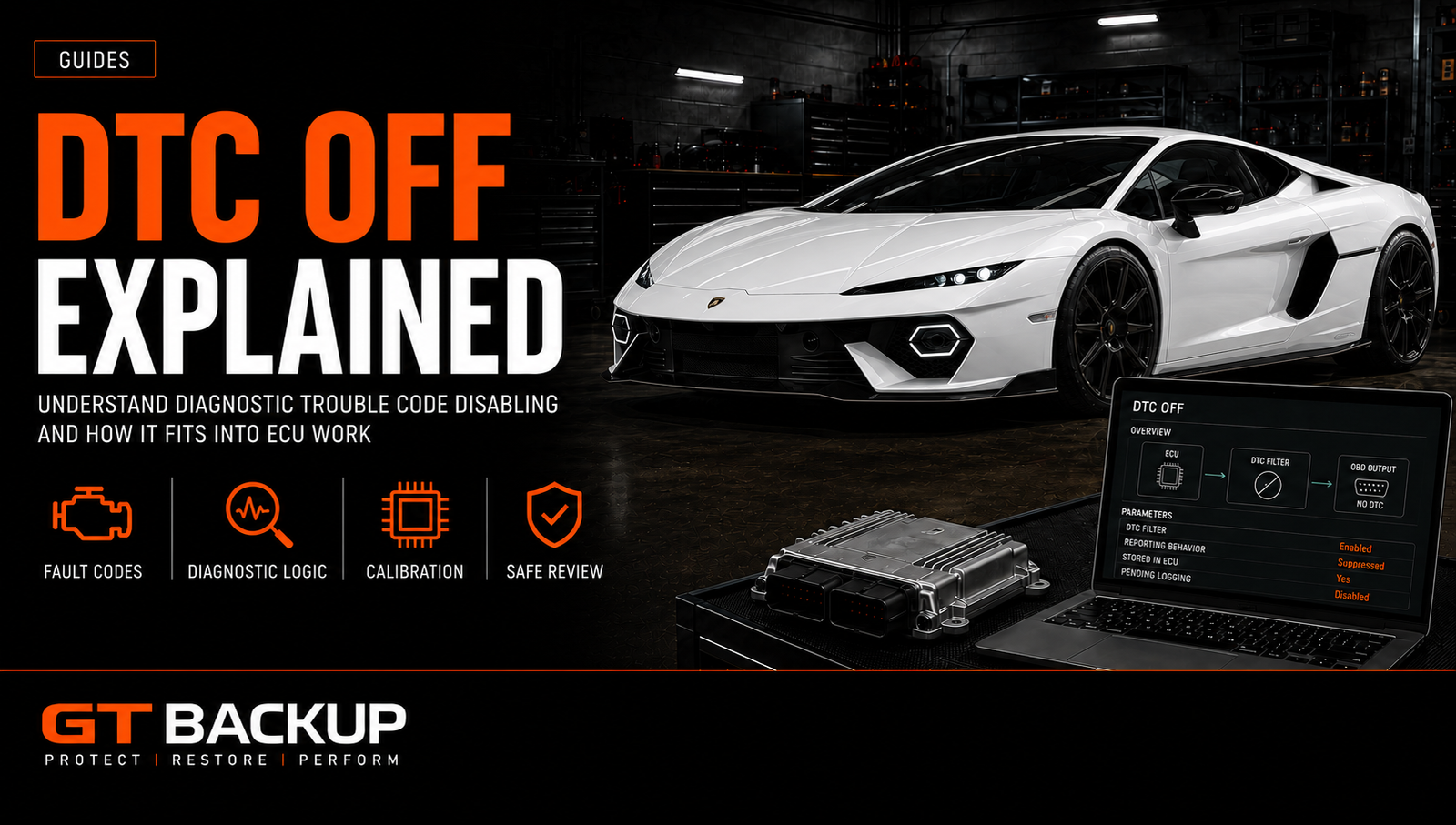
DTC off does not repair a fault: it changes the ECU so that selected diagnostic information is no longer reported normally. That can hide the warning lamp, prevent a code from returning or alter a protective response, while the failed sensor, wiring, actuator or emissions system remains exactly as it was.
A Diagnostic Trouble Code is evidence produced by a monitor. The professional response is to preserve that evidence, test the system, repair the cause and verify that the monitor passes. This guide explains the difference between reading, clearing and suppressing DTCs, why blanket deletion is dangerous, and when factory ECU restoration is needed after previous software modification.
What is a Diagnostic Trouble Code?
A DTC is a structured identifier stored by a control unit when its diagnostic logic detects a defined condition. It may describe an electrical circuit, implausible signal, communication failure, performance problem, emissions threshold or internal-control error. Examples include:
- P-codes: powertrain faults involving the engine, transmission and emissions systems;
- B-codes: body systems;
- C-codes: chassis systems;
- U-codes: network and communication faults.
The first character and digits do not tell the entire story. Generic OBD codes may be accompanied by manufacturer-specific codes, failure-type bytes, status information and subcodes. A complete diagnostic report is more valuable than a shortened code displayed by a basic reader.
A DTC is not automatically a parts-replacement instruction
A code identifies the monitor that failed, not necessarily the component that must be replaced. For example, a NOx-sensor communication code may result from a failed sensor module, but also from damaged wiring, poor power supply, corrosion or a network fault. HELLA’s NOx sensor diagnostic example recommends checking connectors, power supply and CAN communication before condemning the sensor.
Similarly, insufficient EGR flow can result from a blocked passage, vacuum problem, sensor error or valve fault. DPF efficiency, boost-pressure and catalyst codes also require supporting tests. Replacing the named component without checking the circuit and operating conditions can be expensive and ineffective.
Reading, clearing and DTC off are different operations
Reading a DTC
Reading retrieves the code and its status from the control unit. A capable tool may also display freeze-frame data, occurrence count, mileage, environmental conditions and diagnostic test results. This is a non-destructive first step and should be completed before any reset.
Clearing a DTC after diagnosis or repair
Clearing erases eligible fault-memory records and resets some associated information. The ECU’s diagnostic monitor remains active. If the problem persists and the enabling conditions occur again, the code should return. This makes clearing useful after repair or as a controlled diagnostic step.
DTC off or DTC removal
DTC off modifies control-unit software or calibration so that selected fault reporting no longer behaves as originally intended. Depending on the file and ECU, it may affect code storage, warning-lamp requests, limp-mode reactions or parts of a monitor. The ECU can therefore appear “clean” even when the underlying fault remains.
Clearing asks the original monitor to test the repair again. DTC off changes what the monitor is allowed to report.
Why freeze-frame and status data matter
Before clearing any fault, preserve:
- the complete code and manufacturer subcode;
- whether it is current, pending, stored or permanent;
- freeze-frame engine speed, load, temperature and voltage;
- distance or time since the fault occurred;
- monitor readiness and test results;
- related codes in other modules;
- ECU hardware and software identification.
A low-voltage communication code recorded during starting needs a different investigation from the same code appearing at normal charging voltage on the motorway. Without context, the code alone can send diagnosis in the wrong direction.
Current, pending, stored and permanent codes
Terminology varies by tool, but the distinctions are useful:
- Current or active: the fault condition is present now or during the latest test.
- Pending: the monitor detected a possible fault but has not yet met all confirmation criteria.
- Stored or history: the fault occurred previously and remains recorded.
- Permanent: an emissions-related record that normally clears only after the ECU confirms successful operation over the required monitoring sequence.
A permanent code should not be attacked with repeated clearing. The repair must be verified and the monitor must complete. If the code remains because the original diagnostic logic has been modified or the ECU contains the wrong software, factory restoration may be necessary.
Why blanket DTC off is dangerous
Blanket deletion or large unsupported code lists can blind the workshop and owner to genuine problems. Consequences may include:
- loss of early warning for wiring and sensor faults;
- hidden overboost, fuelling, temperature or pressure problems;
- disabled evidence for DPF, EGR or SCR diagnosis;
- unexpected engine or transmission protection behaviour;
- readiness monitors that do not operate correctly;
- increased emissions and inspection failure;
- secondary damage because the original fault continues unnoticed;
- future technicians receiving misleading scan results.
Even where one requested code appears harmless, it may share a monitor, failure path or reaction with other functions. A poorly prepared file can suppress more than the label suggests. The absence of a dashboard warning is not proof that the system works.
DTC off and emissions systems
Codes for the DPF, EGR, AdBlue/SCR, oxygen sensors, NOx sensors and catalysts form part of the vehicle’s emissions monitoring. Suppressing them can reduce the effectiveness of on-board diagnosis and conceal failure of manufacturer-fitted pollution-control equipment.
European emissions legislation defines and prohibits defeat devices that reduce emissions-control effectiveness, subject to limited legal exceptions in the legislation—not a general workshop permission to hide faults. The consolidated Regulation (EC) No 715/2007 includes the prohibition and OBD framework.
For UK inspections, the MOT inspection manual includes checks of the engine malfunction indicator lamp on applicable vehicles as well as visible emissions-control equipment. Local rules vary, but hiding the lamp or suppressing emissions faults is not a substitute for compliant repair.
What about a “residual” DTC after repair?
A code that returns after parts replacement is not automatically residual or harmless. Check these possibilities:
- The original root cause was not correctly identified.
- The new component is incorrect, defective or not coded.
- Wiring, power, ground or communication remains faulty.
- A required adaptation, reset or priming procedure was skipped.
- The monitor has not yet completed under valid conditions.
- A permanent code is waiting for successful drive cycles.
- The ECU contains an old modified file or incompatible calibration.
- A manufacturer software update or technical bulletin applies.
Only after the full manufacturer diagnostic procedure is complete should a workshop classify a warning as erroneous. The correct remedy may be an OEM software update, recoding or restored original calibration—not an arbitrary suppression.
A professional workflow before considering software
1. Confirm the customer complaint
Record warning messages, drivability symptoms and when they occur. Ask about recent battery failure, repairs, ECU programming, replacement parts and previous emissions modifications.
2. Perform a complete vehicle scan
Do not read only the engine ECU. Network, body, transmission and aftertreatment modules can contain related evidence. Save the report before clearing anything.
3. Use freeze frames and live data
Reproduce the operating conditions safely. Compare requested and actual values, inspect signal plausibility and use actuator tests where the manufacturer permits them. HELLA’s control-unit diagnostic guidance demonstrates using fault memory, parameters, adaptations and circuit diagrams together rather than relying on a code alone.
4. Test the circuit and component
Check connectors, wiring, voltage, ground and communication with the appropriate equipment. Inspect mechanical and pneumatic causes. Follow the exact pinout and test limits in manufacturer information.
5. Repair and complete required procedures
Install the correct component, repair the circuit and perform coding, adaptation, calibration, priming or reset functions where required.
6. Clear, validate and rescan
Clear eligible codes after repair, drive the vehicle under the monitor’s enabling conditions and rescan for current, pending and permanent faults. Confirm that live data and readiness are credible.
When previous DTC off software is already present
Unknown ECU software changes the diagnostic starting point. Signs can include:
- known disconnected components with no corresponding faults;
- warning lamps or limp strategies behaving unexpectedly;
- readiness monitors remaining unsupported or incomplete;
- different software identification from the expected vehicle level;
- large modified regions in a file comparison;
- a vehicle history mentioning a delete or remap.
Preserve the current read before doing anything. Identify the exact ECU hardware and software, then compare the file against a verified original. If monitoring has been suppressed, restore the correct factory calibration while preserving required vehicle-specific data. Our ECU restoration guide explains matching, backups, checksums and validation.
Factory restoration does not erase mechanical faults
After original software is restored, previously hidden DTCs may appear. That is often valuable: the ECU is reporting the hardware condition honestly again. The workshop should then diagnose and repair each active fault using the manufacturer’s procedure.
Factory restoration can reinstate:
- original fault monitors and thresholds;
- warning-lamp requests;
- protective reactions;
- DPF regeneration logic;
- EGR and SCR diagnostic strategies;
- readiness monitoring.
It cannot repair a broken wire, blocked filter, failed sensor, leaking injector or damaged catalyst. Software and hardware must both return to a valid state.
DTC off versus safer workshop actions
- Intermittent historic code: preserve evidence, inspect, clear once and retest.
- Current electrical code: test the circuit and repair it.
- Code after component replacement: verify part number, installation, adaptation and root cause.
- Permanent emissions code: complete repair and successful monitor cycles.
- Known manufacturer software issue: apply the approved update or calibration.
- Unknown modified ECU: archive it, identify it and restore the correct original.
- Multiple missing monitors: investigate previous software manipulation before trusting the scan.
Frequently asked questions about DTC off
Is clearing a DTC the same as DTC off?
No. Clearing removes stored records while leaving the original monitor active. DTC off modifies how the ECU reports or reacts to a defined fault.
Will DTC off repair limp mode?
It may hide or alter one trigger, but it does not repair the condition that caused protection. Removing a warning while excessive pressure, temperature or fuelling remains can increase risk.
Can a workshop remove one harmless code?
The code should first be diagnosed according to the vehicle manufacturer’s procedure. If the warning results from a recognised software error, use the approved update, coding or calibration. For a road vehicle, arbitrary suppression is not the equivalent of repair.
Why did codes appear after restoring the ECU?
The modified file may have hidden them. Once factory monitoring returns, the ECU can detect missing or faulty hardware again. Repair those causes and validate the monitors.
Should the current modified file be kept?
Yes. Archive the exact read for traceability and recovery, even when it is unsuitable for continued use. Label it clearly as the received file rather than an original.
DTC off: the correct conclusion
Fault codes are diagnostic evidence. Read them completely, preserve their context, test the vehicle, repair the proven cause and let the original monitor confirm success. Blanket DTC removal trades a visible warning for hidden technical risk.
If a previous file has disabled fault reporting, GTBackup can help a professional workshop compare the read with the correct factory calibration. Contact GTBackup with the ECU identification, full scan and tool read, or review file-service pricing. The objective is an ECU that reports honestly and a vehicle repaired at the source—not simply a dashboard with fewer messages.