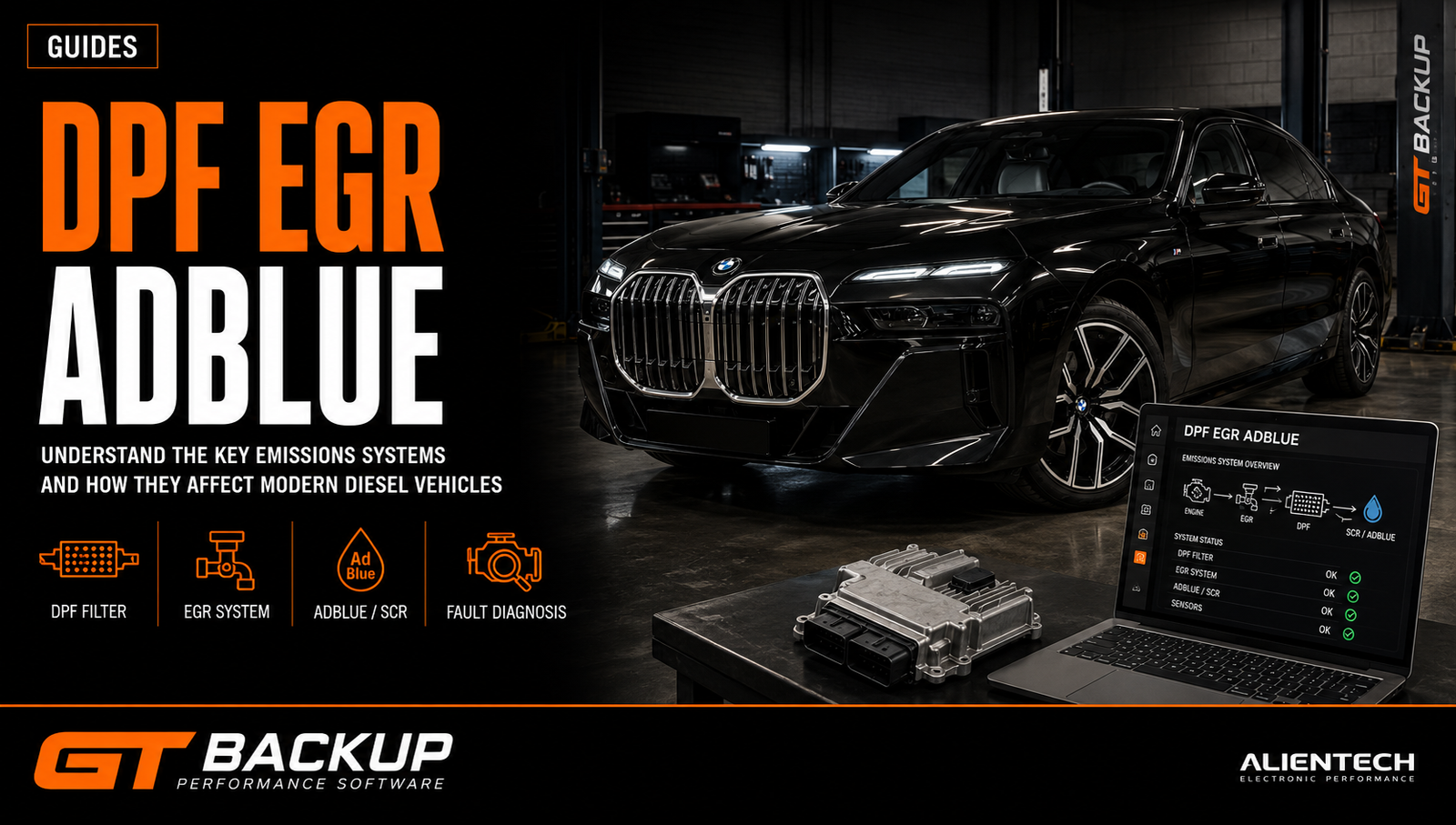
DPF, EGR and AdBlue are three different emissions systems, not one combined component. The DPF traps particulate matter, EGR reduces the conditions that create nitrogen oxides inside the engine, and AdBlue/SCR treats NOx in the exhaust. They share sensors, ECU strategies and operating conditions, so one fault can influence the others—but replacing or deleting all three without diagnosis is not a repair.
This guide explains the complete DPF EGR AdBlue chain, how the systems interact, which checks should come first and how to return a previously modified vehicle to a functioning factory configuration. Exact layouts and test values vary by vehicle, so manufacturer service information remains essential.
DPF EGR AdBlue: three systems with different jobs
DPF: trapping soot from diesel combustion
The diesel particulate filter captures solid soot particles while allowing exhaust gas to pass through porous walls. As soot accumulates, the ECU estimates filter loading using differential pressure, temperature, distance, fuel use and operating history. Regeneration raises exhaust temperature to burn soot into gas, leaving a smaller amount of non-combustible ash behind.
HELLA’s exhaust aftertreatment guide explains that active regeneration can raise DPF temperature to approximately 600–650°C and that ash remains in the filter. Soot may be regenerated; accumulated ash eventually requires professional cleaning or replacement.
EGR: reducing NOx formation inside the engine
Exhaust gas recirculation sends a controlled amount of exhaust gas back into the intake under selected conditions. This lowers peak combustion temperature and reduces NOx formation. The ECU may assess EGR operation through valve position, fresh-air mass, manifold pressure, temperature and differential-pressure data.
An EGR problem can involve the valve, cooler, bypass, throttle, vacuum circuit, electrical control, intake deposits or a supporting sensor. A correct valve-position signal does not prove that gas is flowing through a blocked passage.
AdBlue and SCR: treating NOx after combustion
AdBlue, also known as diesel exhaust fluid, is a high-purity urea solution. The system pumps and injects it upstream of an SCR catalyst. Under suitable temperature conditions, the resulting ammonia reacts with NOx and converts it mainly into nitrogen and water.
The SCR system can include a tank, level/quality sensing, heaters, pump, pressure sensor, heated lines, dosing injector, exhaust-temperature sensors, NOx sensors and an SCR catalyst. HELLA notes that the NOx sensor supports effective AdBlue dosing and emissions monitoring.
How DPF EGR AdBlue systems interact
They target different pollutants, but they operate in the same engine and exhaust environment. Important interactions include:
- poor combustion can create excess soot, filling the DPF faster;
- a cold-running engine may reduce EGR activity, regeneration opportunities and SCR efficiency;
- incorrect EGR flow can alter engine-out NOx and soot production;
- a restricted DPF can increase exhaust backpressure and affect turbocharger and EGR behaviour;
- failed temperature sensors can prevent both regeneration and AdBlue dosing;
- an exhaust leak can distort pressure, oxygen, temperature or NOx information;
- modified ECU software can suppress monitors or change several strategies at once.
This is why a dashboard may show several emissions codes after one root fault. A failed exhaust-temperature sensor, for example, can interrupt DPF regeneration and SCR dosing. Replacing the DPF and NOx sensors would not repair the original sensor circuit.
Multiple emissions codes do not automatically mean multiple failed systems. Diagnose the first cause and separate primary faults from consequences.
Common warning signs across DPF EGR AdBlue systems
Symptoms overlap, but some patterns help guide the initial checks:
- DPF warning or high soot load: frequent regeneration, rising oil level, loss of power, high differential pressure or regeneration inhibited.
- EGR flow or position fault: rough idle, hesitation, smoke, insufficient/excessive-flow codes or plausibility errors.
- AdBlue/SCR warning: reagent message, NOx efficiency code, dosing-pressure fault or countdown to no restart.
- Shared symptoms: engine-management light, limp mode, poor economy, cooling fan activity and several related DTCs.
Do not rely on the wording of the dashboard alone. Record the exact message, remaining distance in any countdown and the conditions in which it appeared. A complete diagnostic scan is more useful than clearing one code at a time.
A professional DPF EGR AdBlue diagnostic order
1. Preserve the evidence before resetting anything
Read every relevant module and save current, pending and permanent DTCs, manufacturer subcodes, freeze frames and monitor status. Record ECU identification and software versions. A reset destroys clues such as temperature, load and mileage when the monitor failed.
2. Confirm the mechanical condition of the engine
Aftertreatment cannot compensate indefinitely for poor combustion. Check coolant temperature, oil condition, injector correction, air and boost leaks, turbocharger operation, crankcase ventilation and any misfire or compression concern. Repair excessive oil consumption or fuelling faults before repeatedly regenerating a filter.
3. Inspect the exhaust and sensor wiring
Look for leaks, damaged connectors, melted wiring, road impact, loose pressure hoses, crystallised AdBlue and signs of coolant loss. Confirm that exhaust-temperature values are plausible when cold and rise logically as the engine warms. HELLA recommends visual inspection and evaluation of live sensor values as part of exhaust-system troubleshooting.
4. Evaluate DPF loading correctly
Compare calculated soot, measured soot where available, ash estimate and differential pressure at specified engine speeds. Inspect both pressure hoses and confirm the sensor reads near zero with the engine stopped where the service method expects it. High pressure can indicate restriction, but a damaged hose or biased sensor can imitate a blocked filter.
A forced regeneration should only be considered after proving that the filter load, engine condition, oil level and temperature sensors are within the manufacturer’s safe limits. Regeneration is not a cure for ash, melted substrate or a continuing soot-production fault.
5. Test EGR flow, not only valve position
Command the valve with a suitable diagnostic tool and observe position, fresh-air mass and manifold pressure. On vacuum-operated systems, test the supply, solenoid and hoses. If the actuator moves but airflow does not change, inspect the cooler and passages for restriction. Our clogged EGR valve guide covers cleaning and replacement decisions in detail.
6. Test AdBlue supply and SCR efficiency
Check fluid level and quality status, pump pressure, heater circuits, dosing command, injector quantity and upstream/downstream NOx behaviour under the documented conditions. A catalyst-efficiency code does not prove that the catalyst has failed; dosing, temperature, exhaust leaks and NOx sensor accuracy must be confirmed first.
After repair, some SCR systems need priming, component initialisation or a defined road test. HELLA provides vehicle-specific examples in which upstream and downstream NOx values are compared only after the SCR catalyst reaches a suitable temperature.
DPF EGR AdBlue root causes and their consequences
Thermostat or temperature-sensor fault
If the engine or exhaust does not reach the expected temperature, EGR operation may change, DPF regeneration can be inhibited and SCR dosing may remain limited. One temperature problem can therefore produce warnings in more than one subsystem.
Excessive soot production
Injector faults, boost leaks, restricted intake, incorrect airflow measurement, turbocharger problems and oil consumption can overload the DPF. Cleaning the filter without addressing the engine fault leads to rapid recurrence.
Blocked DPF and high exhaust backpressure
A severely restricted filter can affect turbocharger efficiency and the pressure relationships used by EGR. HELLA describes examples where excessive DPF backpressure contributes to secondary turbocharger damage. Diagnose the whole air and exhaust path before replacing isolated parts.
EGR cooler or valve problem
Incorrect EGR flow changes combustion temperature, air mass and engine-out emissions. A leaking cooler may also cause coolant loss or contamination. Repair the physical fault and validate the flow rather than relying on a software switch.
AdBlue pressure, injector or NOx sensor fault
A weak pump, blocked injector, crystallisation, wiring damage or inaccurate NOx sensor can trigger SCR efficiency faults and a countdown. Compare commanded and actual behaviour before replacing the catalyst. See our AdBlue warning guide for the no-start workflow.
Unknown or modified ECU software
A previous “DPF EGR AdBlue off” file may suppress DTCs, disable regeneration, stop dosing or alter related torque and temperature strategies. The workshop can then receive incomplete diagnostic evidence even after the hardware has been repaired.
What a DPF EGR AdBlue “combo delete” changes
The expression usually refers to software modifications intended to disable several manufacturer emissions functions together. Hardware may also have been emptied, blanked, unplugged or replaced by an emulator. Because the systems are interconnected, a poor-quality file can affect far more than three warning lights.
Potential consequences include:
- missing or suppressed DTCs;
- disabled DPF regeneration and soot calculations;
- altered EGR commands and airflow diagnostics;
- stopped AdBlue dosing or SCR inducement logic;
- readiness monitors that never complete correctly;
- inconsistent live data and difficult future diagnosis;
- increased particulate and NOx emissions;
- inspection, road-use and resale problems.
The European Commission’s Joint Research Centre has documented tampering practices affecting SCR, DPF, GPF and EGR systems, including ECU remapping and emulators. Bundling the functions does not make the modification technically harmless.
Why restoration is more than writing an original file
Returning a modified vehicle to factory operation normally requires both hardware and software work:
- identify which components are missing, damaged or bypassed;
- repair or refit the correct DPF, EGR and SCR hardware;
- remove emulators, blanking plates and unsuitable wiring changes;
- identify the exact ECU hardware and software version;
- preserve the current read and vehicle-specific data;
- write the correct factory calibration through a supported method;
- complete resets, adaptations, priming and coding where required;
- run the relevant monitors and validate the complete system.
A generic “stock” file from the same engine is not automatically correct. Production version, transmission, market and emissions level can change the required software. Our ECU restoration guide explains file matching, backups, checksums and data preservation.
Road legality and inspection
Manufacturer-fitted emissions controls must remain effective on vehicles used on public roads under the applicable rules. The UK MOT inspection manual includes visible, identifiable emissions-control equipment such as DPFs, EGR valves and SCR components, and classifies missing, obviously modified or defective equipment according to its inspection criteria.
Rules and enforcement vary by country and vehicle category, so workshops should check the current local requirements. A software restoration does not make an empty DPF or missing catalyst compliant; the hardware must also match the approved configuration.
DPF EGR AdBlue post-repair validation checklist
- Complete diagnostic scan contains no relevant current faults.
- Coolant and exhaust temperatures are plausible.
- DPF differential pressure and soot values respond normally.
- Regeneration status and history are credible.
- EGR command produces the expected airflow response.
- AdBlue pressure and dosing tests pass.
- Upstream and downstream NOx data support SCR conversion.
- Required adaptations and component resets are complete.
- No emulator or bypass remains connected.
- ECU identification matches the intended factory software.
- Readiness monitors complete during an appropriate road test.
Do not declare the vehicle repaired solely because warning lights are absent after code clearing. The monitors must run under suitable load and temperature, and pending faults must be checked again.
DPF EGR AdBlue: the correct combined approach
Treat DPF, EGR and AdBlue as one coordinated diagnostic project but three distinct systems. Begin with engine condition and shared sensors, then test particulate-filter loading, EGR flow and SCR dosing separately. Repair the proven mechanical causes before restoring verified factory ECU software.
GTBackup assists professional workshops that need to identify and restore original ECU calibration after a previous combined modification. Contact GTBackup with the ECU identification, tool and complete read, or review file-service pricing. Include the diagnostic scan and describe which DPF, EGR and AdBlue components have already been repaired or refitted.