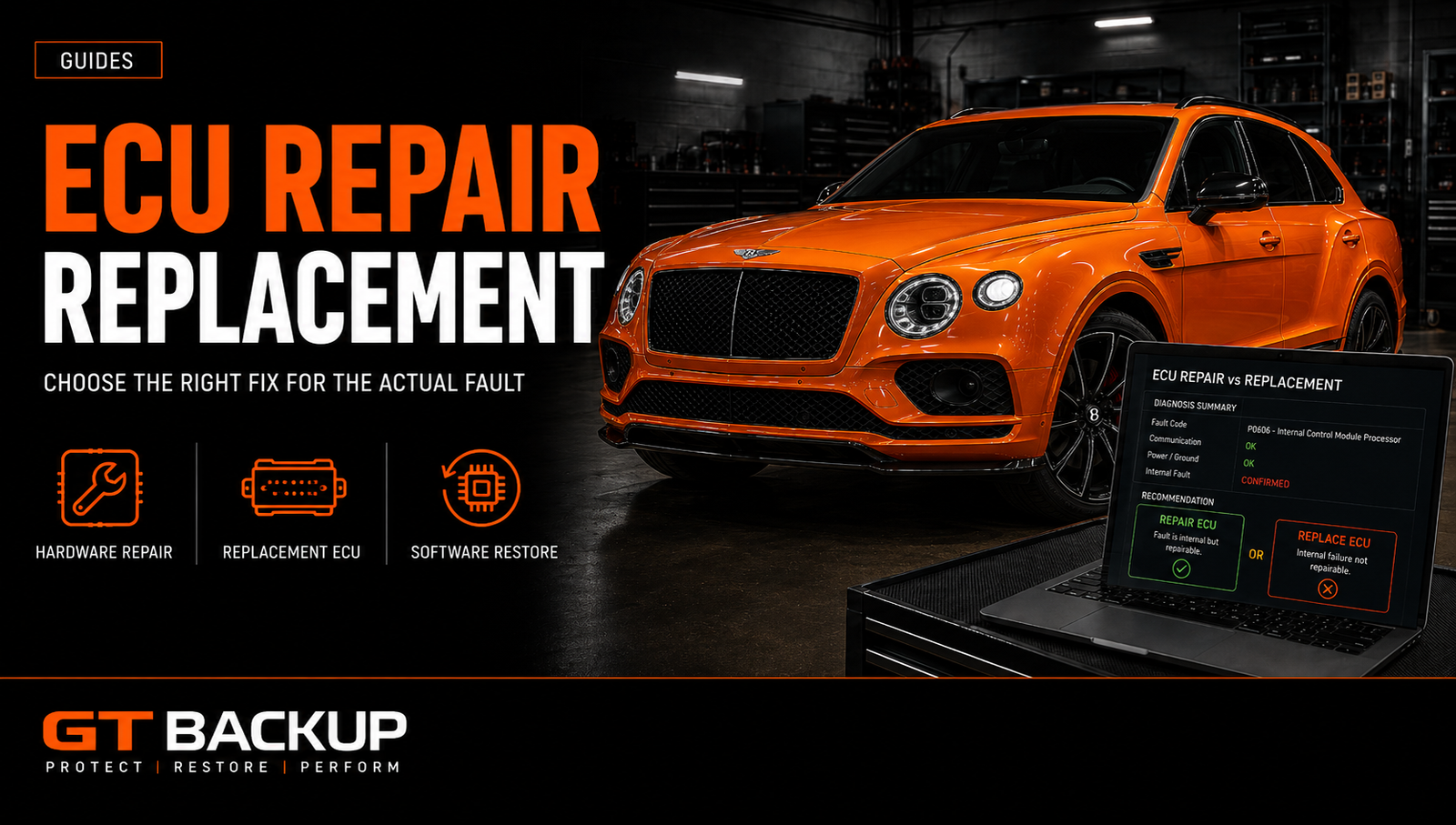
ECU repair vs replacement is not simply a choice between a cheap fix and an expensive part. The correct route depends on whether the fault comes from the controller hardware, corrupted software, vehicle wiring, power supply, communication network or coding. Accurate diagnosis should always come before removing, opening or programming the ECU.
Replacing a healthy controller will not repair a failed relay, poor ground or shorted actuator. In the same way, rewriting software cannot repair a burnt driver or damaged processor. This guide explains how to separate those cases, preserve the original data and choose between electronic repair, software restoration, cloning and compatible replacement.
ECU repair vs replacement starts with diagnosis
An ECU may appear faulty when low voltage, poor grounds, damaged wiring, water inside a connector, a shorted sensor or actuator, or a communication-network problem causes the symptoms. Before condemning the controller, record all diagnostic trouble codes and freeze-frame data. Then test its power supplies, grounds, ignition feeds and network connections under load.
Confirm whether the ECU communicates consistently and whether other modules report lost communication. Inspect relevant fuses, relays and connectors, then compare requested and actual values where communication remains available. A controller replacement should follow evidence, not a single fault-code description.
| Confirmed situation | Likely route | Essential checks |
|---|---|---|
| Localised board, connector or driver damage | Electronic ECU repair | Board condition, failed component and external cause |
| Incorrect or corrupted software | Software recovery or stock restoration | Exact HW/SW match, protocol and original backup |
| Severe corrosion, board damage or failed processor | Compatible replacement | Part numbers, hardware generation, coding and security pairing |
| Recoverable original with compatible donor ECU | Cloning or data transfer | Flash, EEPROM, processor and hardware compatibility |
| External supply, wiring or actuator fault | Repair the vehicle first | Voltage, grounds, current draw, relays and network integrity |
When electronic ECU repair is appropriate
Electronic ECU repair aims to retain the vehicle’s original controller by correcting a confirmed hardware failure. Repairable faults can include damaged power-supply stages, output drivers, communication transceivers, cracked solder joints, broken connector pins or limited corrosion. Keeping the original unit can preserve its software, coding and vehicle-specific identity data.
A dependable repair requires more than replacing the visibly damaged component. The technician must determine why it failed. A shorted injector, solenoid, ignition coil, wiring harness or incorrect jump-start can damage the repaired circuit again as soon as the ECU returns to the vehicle.
When ECU repair is not dependable
Extensive water damage, carbonised multilayer-board tracks, internal short circuits, failed processors or unavailable components may make repair unreliable or uneconomical. Previous unsuccessful work can also remove pads, damage vias or contaminate the board. In these cases, a compatible replacement with a documented programming route may offer the safer result.
A repair specialist should distinguish between “technically possible” and “dependable for vehicle service.” If the damaged area cannot be inspected or tested adequately, repeated repairs can cost more than a correctly prepared replacement.
Software restoration before ECU replacement
Healthy hardware may still contain interrupted, corrupted or incompatible software. Symptoms can appear after failed programming, an incorrect calibration, low voltage during writing or use of a mismatched file. When the ECU remains accessible through a supported protocol, restoring correctly matched original software may avoid replacement.
Match the hardware number, software family, calibration version, vehicle application and programming method. A file from a similar engine or an ECU with the same case is not automatically compatible. Preserve every readable original memory before attempting recovery, even when the existing data appears damaged.
Replacement ECU compatibility checks
A replacement ECU is rarely a simple plug-in component. The visible manufacturer number is important, but compatibility may also depend on hardware revision, processor, memory layout, software branch, emissions specification, gearbox type and vehicle communication interfaces.
- Compare the complete original and donor manufacturer references.
- Confirm the ECU family and hardware generation.
- Check processor and available memory configuration.
- Verify vehicle, engine, transmission and emissions application.
- Identify the required programming, coding and security procedure.
- Confirm that diagnostic and programming tools support both units.
Workshop rule: confirm the replacement and programming path before purchasing the donor ECU.
New, remanufactured and used replacement ECUs
A new genuine controller usually offers the clearest manufacturer programming route, but availability and cost can be limiting. A professionally remanufactured ECU may provide a tested alternative when the supplier documents the application, warranty and required coding. A used controller can be economical, but its history, internal condition and compatibility may be unknown.
Do not assume that a used unit is healthy because it communicates on a bench. It may contain unrelated coding, modified calibration, stored faults or developing electronic damage. Record its identification and preserve its data before any preparation or transfer.
Cloning in an ECU repair vs replacement workflow
ECU cloning transfers the required software, calibration and vehicle-specific data from the original controller to compatible replacement hardware. Depending on the architecture, the job may require internal flash, external flash, EEPROM, emulated EEPROM or processor-specific data. Copying only the calibration area may not transfer coding or identity information.
Cloning works only when the source data remains readable and the donor hardware accepts the required memories. A complete-looking backup cannot make incompatible ECUs interchangeable. Compare both units and consult the dedicated ECU cloning guide before writing donor hardware.
Virgin ECU, coding and security pairing
A virgin ECU is placed in a manufacturer-defined initialisation state so the vehicle can legitimately program or adapt it. “Virgin” does not mean universally blank. The required state, retained software and pairing process differ between controller families and manufacturers.
A replacement may require online programming, variant coding, immobiliser pairing, component-protection adaptation or manufacturer-specific commissioning. Plan access to the correct diagnostic system before installation. See the explanation of a virgin ECU for the difference between initialisation and cloning.
Data to preserve before repair or replacement
- Save the complete ECU identification and diagnostic report.
- Photograph the label, connectors and visible damage.
- Record the vehicle, engine, transmission and relevant configuration.
- Read the available flash, EEPROM and processor memories.
- Record the programming tool, version, protocol and connection mode.
- Keep the first successful reads untouched in separate storage.
- Document all previous programming and repair attempts.
A calibration-only OBD read may be enough for a defined software operation but insufficient for cloning or security-data recovery. Where supported, preserve a verified full ECU backup before modifying either controller.
Cost comparison must include the complete job
The lowest component price does not always produce the lowest total repair cost. Compare diagnosis, removal, electronic work, software recovery, donor purchase, coding, security pairing, installation and final testing. Vehicle downtime and the risk of repeating the original failure also matter.
A successful original-controller repair can avoid donor preparation and coding. Conversely, repeated attempts on severely damaged hardware may exceed the cost of replacement. The best choice is the route with the strongest diagnosis, compatibility evidence and verification—not the cheapest isolated line item.
Common ECU repair vs replacement mistakes
- Buying a donor from vehicle model alone without comparing ECU references.
- Replacing the controller before testing its power, grounds and network.
- Writing an unverified file selected only by advertised engine power.
- Overwriting the original read with a modified or donor file.
- Cloning data into incompatible hardware.
- Ignoring the shorted component or wiring fault that damaged the original ECU.
- Purchasing a replacement before confirming the coding and pairing tools.
Verification after ECU repair or replacement
After installation or programming, confirm stable communication and correct ECU identification. Scan every relevant control unit, complete required coding or adaptations, and verify that immobiliser and component-protection functions operate normally. Clear faults only after recording them, then repeat the scan after an appropriate test.
Check the system connected to the original failure: actuator current, sensor supply, charging voltage, grounds, CAN communication or water ingress. A successful programming message confirms data transfer; it does not prove that the initial electrical problem has been repaired.
ECU repair vs replacement: the practical decision
Choose ECU repair when testing confirms a localised, repairable hardware fault and the original controller remains a dependable base. Choose software restoration when the electronics are healthy but the program or calibration is corrupted or incompatible. Choose a replacement when the original hardware is beyond reliable repair and a compatible programming route exists.
Preserve the original data before every route, correct the cause of failure and verify the vehicle after installation. Continue with the guides to stock ECU restoration, ECU full reads, and safe ECU writing, or contact GTBackup when file or replacement compatibility is uncertain.