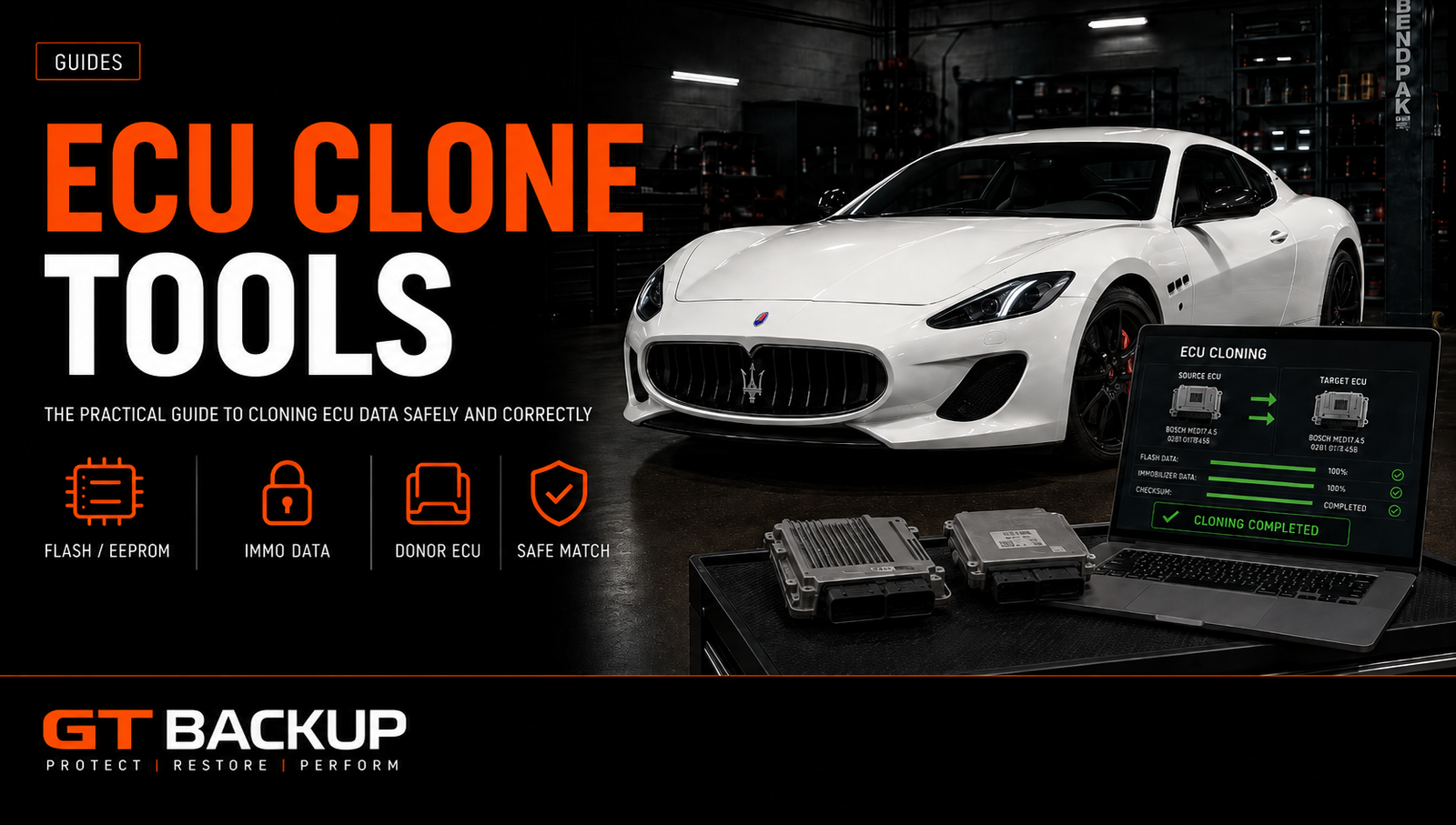
ECU clone tools are professional programmers used to transfer supported data from an original control unit to a compatible replacement. The term is often confused with “cloned tools,” meaning counterfeit copies of genuine programming hardware. These are two very different subjects: ECU cloning is a legitimate repair workflow, while counterfeit programmers can introduce software, support and reliability risks.
What are ECU clone tools?
An ECU clone tool reads the data required from an original engine or transmission control unit and writes compatible data to a replacement. When the protocol and donor unit permit it, the replacement can retain the original vehicle configuration, calibration and identification needed for operation.
Professional platforms such as Alientech KESS3 and Magic Motorsport Flex publish controller-specific cloning or duplication information. Other programmers may provide physical reads and backups that a qualified specialist can evaluate for a replacement workflow. No tool can clone every ECU, and the word “supported” must be checked for the exact controller family.
ECU clone tools vs cloned programming tools
The similar language creates unnecessary confusion.
| Term | Meaning | Typical purpose | Main concern |
|---|---|---|---|
| ECU clone tool | A programmer with supported ECU duplication functions | Replacing or repairing a failed compatible control unit | Exact protocol, memory coverage and donor compatibility |
| Cloned tool | An unauthorized copy of branded programming hardware or software | Low-cost imitation of a genuine product | Unknown hardware, modified software, absent support and legal risk |
| Full backup | A read containing multiple controller memories where supported | Recovery, repair or cloning preparation | “Full” must be verified from the protocol, not assumed |
A workshop searching for ECU clone tools should therefore decide whether it needs a documented cloning function, a complete read for an external cloning service, or both. It should not treat a counterfeit programmer as an ECU-cloning feature.
How professional ECU cloning works
At a high level, cloning compares the original controller with a compatible replacement, reads the required memories and transfers or adapts the supported data. Some protocols offer a direct one-to-one copy. Others require an online cloning function or technical-support processing because the data must be adapted.
The required content can include flash, EEPROM, microprocessor or external memory data. The exact combination varies by ECU or TCU. A calibration-only file is rarely enough to reproduce the complete identity and configuration of a controller.
Because vehicle security and authorization data may be involved, cloning should be carried out only for lawful repair work on vehicles the workshop is authorized to service. This guide describes the professional workflow without providing immobilizer-bypass procedures.
OBD, Bench and Boot for ECU clone tools
Cloning normally depends on direct control-unit access rather than a routine OBD calibration write.
| Mode | Connection | Role in cloning | Limitations |
|---|---|---|---|
| OBD | Vehicle diagnostic socket | Identification and selected reads or writes | Often does not expose every memory needed for cloning |
| Bench | Closed ECU through its external connector | Direct access to supported memories without opening the unit | Requires exact pinout and regulated power |
| Boot | Opened ECU with circuit-board access | Deeper memory access, full backup or recovery where supported | Requires safe opening, correct probes and greater technical skill |
Manufacturers commonly associate cloning with Bench and Boot protocols. However, connection mode alone does not prove that a clone is possible. The official vehicle list or software instructions must explicitly confirm the available read, write and cloning functions.
Choosing a compatible donor ECU
A replacement that looks identical externally may use different hardware, processor, memory layout or internal software. Part numbers should be compared carefully, but a matching label alone does not guarantee compatibility.
Before purchasing or connecting a donor unit, record:
- the complete original ECU or TCU manufacturer and family;
- hardware and software numbers;
- vehicle application, engine, gearbox and production information;
- processor and memory types where documented;
- connector and board revision;
- the exact cloning status in the tool’s current protocol list.
Some tools label controllers as directly clonable, not clonable, untested or requiring an online service. Treat those categories literally. Writing an original dump into an unverified donor can leave the replacement unusable.
What data does an ECU clone require?
The answer depends on the controller. Flash memory may contain operating software and calibration data. EEPROM can contain configuration, learned values or identity-related information. Internal processor memory may hold additional data required by the unit.
A “full read,” “full backup,” “original file” and “Virtual Read” are not interchangeable:
- Virtual Read: usually supplies a matching original calibration from a database rather than extracting all data from the installed unit.
- Physical read: collects the memories exposed by the selected protocol directly from the controller.
- Calibration read: may contain only the tunable area needed for a remap.
- Full backup: may include several memories suitable for recovery or cloning, but only when the protocol confirms them.
Do not call a file a full backup simply because it is large. Save the read report, protocol, connection mode and memory names alongside every file.
Automatic clone, one-to-one copy and adaptation
Modern ECU clone tools can present different workflow categories. An automatic clone function handles supported conversion through the manufacturer’s system. A one-to-one clone writes the appropriate original memories to a compatible replacement. An adapted clone requires processing because differences between the original and donor prevent a direct copy.
These categories are not interchangeable. If the manufacturer specifies online cloning or technical support, a direct write should not be substituted. The safest approach is the one documented for that exact controller and donor combination.
A safe ECU cloning workflow
- Confirm authorization. Record the vehicle and customer repair request.
- Diagnose the original failure. Make sure the ECU is actually the cause and check power, grounds and communications.
- Identify both units. Compare labels, hardware, software and current protocol coverage.
- Read the official instructions. Confirm the connection mode, pinout, accessories and clone classification.
- Stabilize power. Use a regulated, current-limited bench supply suitable for the controller.
- Read and archive the original. Preserve every available memory and identification report without modification.
- Validate the donor. Do not write until compatibility and the required adaptation method are confirmed.
- Use the documented clone process. Follow the tool manufacturer’s guided procedure or approved support service.
- Verify the result. Reinstall safely, diagnose the vehicle and confirm normal operation before delivery.
When the original ECU cannot be read
A dead or physically damaged original changes the available options. If communication is impossible, a normal one-to-one clone may not be possible because essential vehicle-specific data cannot be recovered.
A specialist may evaluate alternative repair, data recovery or authorized replacement procedures, depending on the controller and available records. Avoid promising a clone before the original unit has been tested in the documented Bench or Boot mode.
Genuine professional ECU clone tools
A genuine platform provides official software, documented protocols, updates, technical support and traceable account conditions. Examples of ecosystems with supported Bench, Boot, backup or cloning workflows include Alientech KESS3 and Magic Motorsport Flex. Exact capabilities still depend on activation, subscription and the controller selected.
Professional ownership costs can include hardware, protocol packages, subscriptions, adapters, a positioning frame, regulated power equipment and training. These costs should be compared with the value of supported procedures and recovery assistance, not only with the purchase price of a bare interface.
Risks of counterfeit cloned tools
Counterfeit hardware may imitate the appearance of an established programmer while using different components, modified firmware or unauthorized software. The workshop cannot assume that the original manufacturer’s instructions, updates or safety checks apply to the copy.
Common business risks include:
- no official technical support or warranty;
- unknown component quality and voltage protection;
- modified software that may require unsafe computer settings;
- no reliable protocol updates or server continuity;
- unverifiable checksum or file handling;
- account, licensing and intellectual-property concerns;
- greater downtime when a read or write fails.
A low purchase price does not limit the cost of a damaged ECU, recovery work, vehicle downtime or customer dispute. For commercial programming, traceability and support are part of the tool.
How to evaluate ECU clone tools
| Question | Why it matters |
|---|---|
| Is the exact ECU listed as clonable? | General brand coverage does not confirm a cloning function |
| Which memories are read? | A calibration file may not include identity or recovery data |
| Does cloning require Master, online service or support? | The workflow and ongoing costs may differ |
| Can the donor references be verified? | External similarity is not enough for compatibility |
| Are updates and support official? | Protocol changes and failed jobs require accountable help |
| What power and adapters are required? | Stable connections are essential for safe direct access |
Official cloning information
Alientech explains supported cloning in its official KESS3 information and marks automatic or online cloning functions in the KESS3 vehicle list. Magic Motorsport publishes a dedicated Flex ECU and TCU duplication list with direct, support-assisted and unsupported classifications.
ECU cloning files and GTBackup
GTBackup supplies ECU and TCU files and evaluates available reads; we do not sell counterfeit programming tools. For a cloning-related request, send the untouched original and donor reads, complete labels, hardware and software references, vehicle details, tool name, protocol, connection mode and every available memory.
We can assess the submitted data, but a file cannot make incompatible hardware compatible or recover information that was never read. Explore our ECU file services or review how our file workflow works.
Conclusion
ECU clone tools are legitimate professional programmers used to duplicate supported control-unit data for repair and replacement. They should not be confused with cloned or counterfeit programming hardware. Successful cloning depends on exact controller support, a compatible donor, complete memory access, stable power and a documented workflow. Genuine tools provide the protocol information and accountability needed to manage those risks.